Is your brand worth paying more for?

Consumers are spending more carefully. But they're still trading up, just not for every brand, and not in every category.

So what makes the difference? When people stretch their budget, what are they actually buying?

Worth Paying More For is MM-Eye's new study of UK consumers exploring the motivations, mindsets and moments that drive premium choice across hotels, haircare, fashion, technology and chocolate.

We believe brands that win on both emotion and commercial excellence are the ones consumers choose to pay more for. Not brands that are merely better, but brands that feel like the best choice. This research puts that thinking to the test.

WPMF 2026

Dive into the data

Immerse it all or dip into one of the questions below.

If what you're reading raises questions about your own brand, we'd love to chat.

Brands think they know what premium means. Consumers suggest otherwise.

What does "premium" really mean in consumers' own words? We gave people a blank box and two minutes, and asked them to describe premium in their own words, focusing on hotels for some, haircare for others. Four things stood out.

Premium is a feeling before it's a fact. The first thing people reach for isn't specification, it's sensation. A premium hotel is somewhere you go "to feel special," where "the lobbies smell good," a place to "switch off and relax" and feel "pampered." Premium haircare is "soft, luxurious hair" that makes you "feel youthful." The language is personal and sensory, closer to how you'd describe a good day than a good product.

But nobody stops at the feeling. They reach for proof. Almost in the same breath, people justify the feeling with evidence: quality, ingredients, service, how long it lasts. And when we asked specifically what would make premium worth paying more for, the proof language sharpened. Haircare had to have "active ingredients" and "actually do everything it claims." A hotel earned its price through "great customer service" and "attention to detail." The feeling opens the door. The proof is how people give themselves permission to walk through it.

Most people do both at once. The most revealing answers weave the two together without noticing. "It can be luxurious and make you feel very special. The quality is very good." Or a haircare buyer describing a product that makes her "look and feel so fresh and vibrant" and "last a long time," so it's "worth every penny to make yourself feel better and happy in your life." That is premium as consumers actually experience it: an emotional pull and a rational proof, running side by side.

Overt status showed up far less than brands tend to assume. Premium is mostly private: about how something feels to you, not how it looks to others. A steady minority reject the premise outright, telling us premium haircare is "basically all the same ingredients, just marketed as premium." Worth knowing who you will never convince.

Which brings us back to the thread running through this study. People don't pay more for reasons alone. They pay more when the feeling and the proof agree. Emotion earns the attention. Proof earns the money. The brands worth paying more for give people both.

"Great amenities and excellent customer service that make you feel comfortable and help you have a relaxing stay. Absolutely worth paying more for."

So here's the question for your brand. When your customers describe why you're worth more, do they lead with the feeling, the proof, or both? And do you actually know?
Premium lives in daydreams and in the everyday

Most of us are quietly sure about where we would trade up. The better car. The phone with the good camera. The hotel with reviews you actually trust. Then the month happens, the basket fills with the same few affordable treats, and the big upgrade waits until next year again.

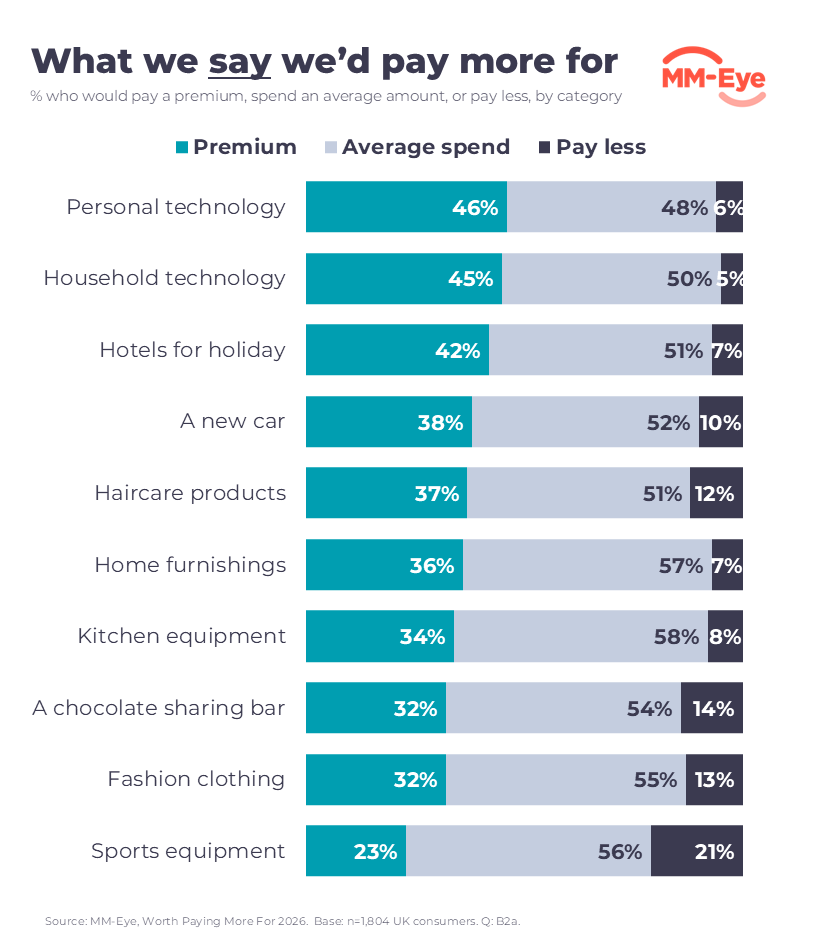
When asked directly, people say they would pay more for the big-ticket categories. Personal technology tops the list at 46%, household technology at 45%, hotels at 42%. This is premium as aspiration, the version of ourselves that trades up when the big purchase finally comes around.

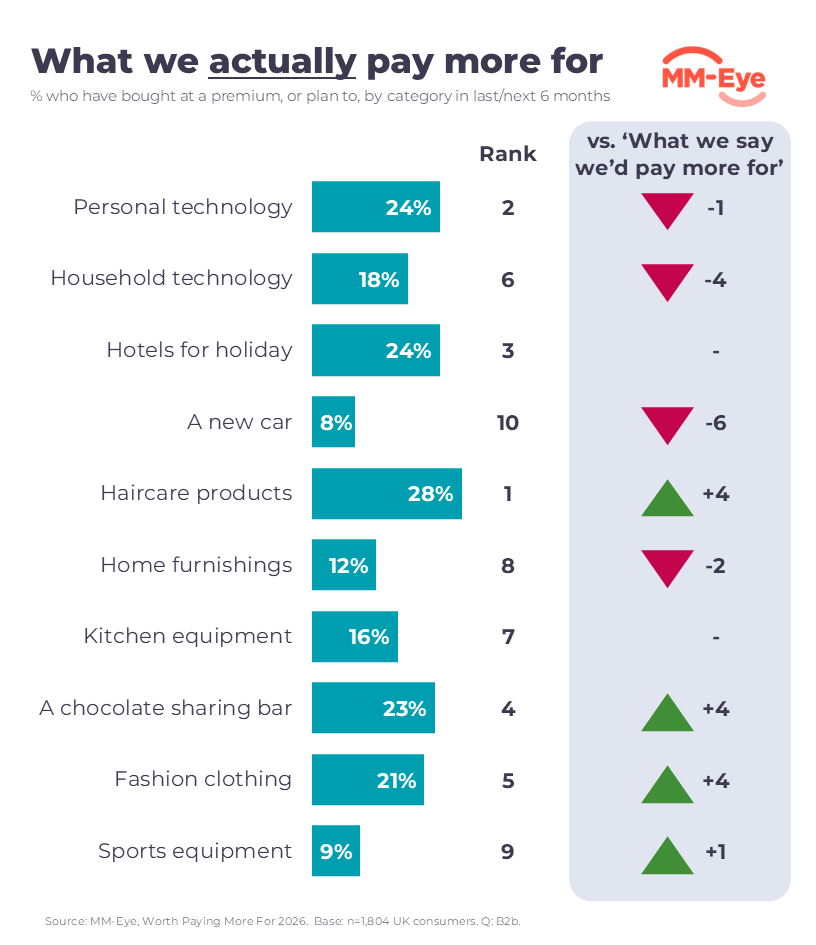
When you compare this to what people have actually bought at a premium, or are firmly committed to buying, the order reshuffles. Haircare jumps to the front at 28%, chocolate climbs to 23%, ahead of household tech (18%). The new car, fourth on aspiration, drops to last at 8%.

Part of this is obvious. You buy chocolate far more often than you buy a car, so of course the everyday categories show up more over six months. But that is exactly the point. Premium is not only the big, occasional splurge people daydream about. It is the small, repeated trade-up that happens in the aisle, week after week, in categories brands often treat as commodities.

In everyday categories, that agreement between the feeling and the proof gets tested and re-won on almost every shop.

WPMF_Post3_Chart_Portrait-1
Chart_Post 3_2

What drives people to pay more in an everyday category?

We spend a lot of time talking about what makes a brand worth paying more for. The feeling that pulls you in, the proof that backs it up, and what happens when the two agree.

That is easy to argue about cars, or watches, or five-star hotels. So we tested it somewhere smaller, more familiar and a good deal more fun. Somewhere we all shop, all have an opinion, and all quietly have a favourite. Chocolate.

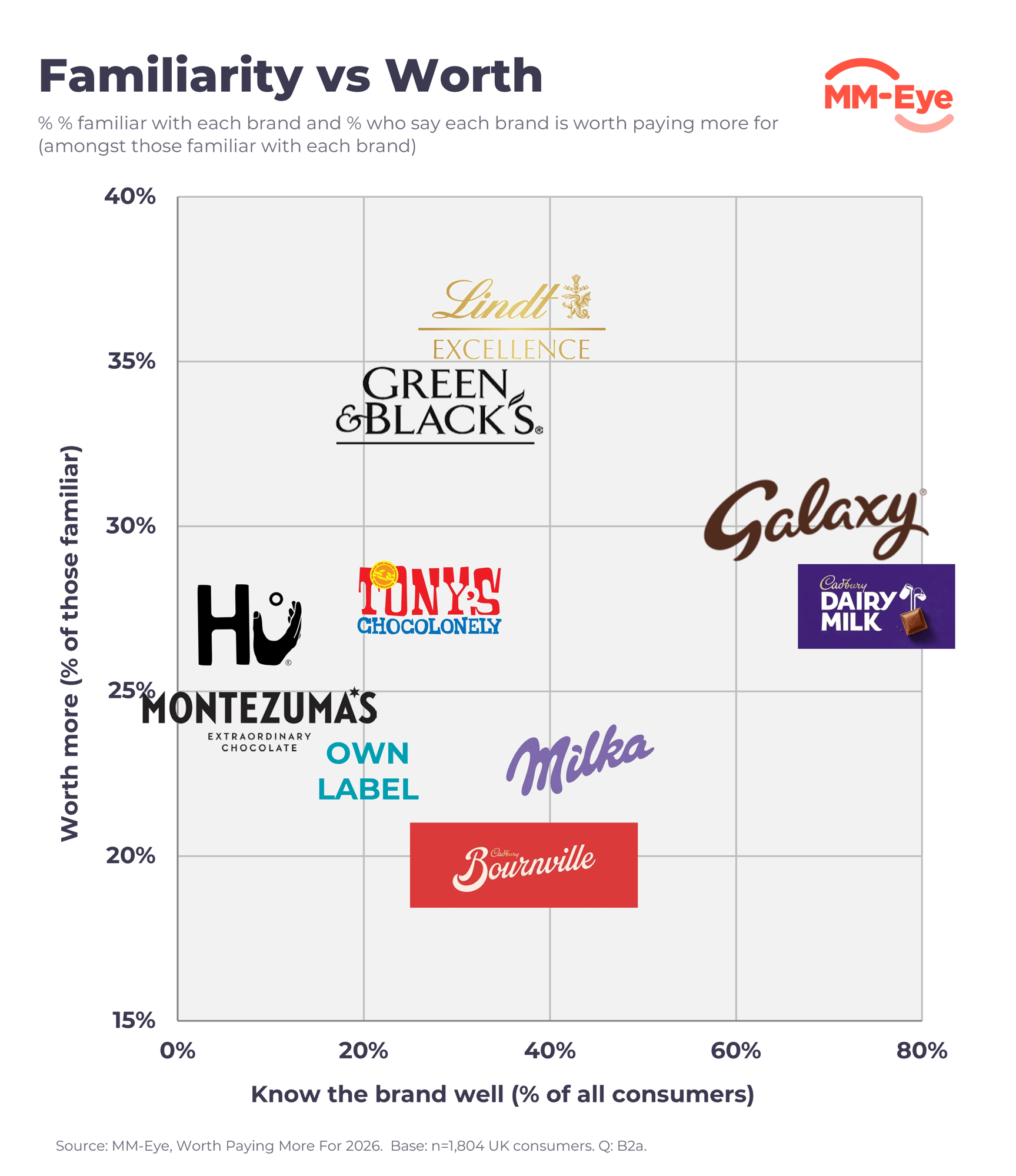
Two things stood out. First, the most famous bars in Britain are not the ones people most often call worth a premium. Fame gets you recognised. It does not earn you the right to charge more. Second, the reasons people pay up arrive in a strict running order, and the brands that run it backwards struggle.

Famous is not the same as worth it

You can be the most recognised chocolate brand in the country and still fail to convince seven out of ten people who know you well that you are worth paying more for. That is not a hypothetical. It is a consistent pattern across our Worth Paying More For study.

If awareness reliably bought pricing power, the more famous brand would win on both numbers, every time. It does not. Cadbury's Dairy Milk is known well by 75% of people, yet only 28% of those familiar with it call it worth a premium. Galaxy, known well by 69%, reaches 30%. Milka, known well by 43%, gets to 23%. Cadbury's Bournville, known well by 37%, lands at 20%. The bar that actually tops the table is Lindt Excellence on 36%, and it is nowhere near the best known of the ten.

Somewhere between "people know us" and "people think we are worth more," a brand has to land a functional advantage, does it actually deliver something better, or an emotional one, does it mean something to me. Neither shows up for free just because the name is recognised, and our data shows brands earning them at very different rates despite similar levels of fame.

Minisite - Famous brands
The sequence brands get backwards

Nobody needs a study to tell them taste matters in chocolate. That was never going to be the interesting finding.

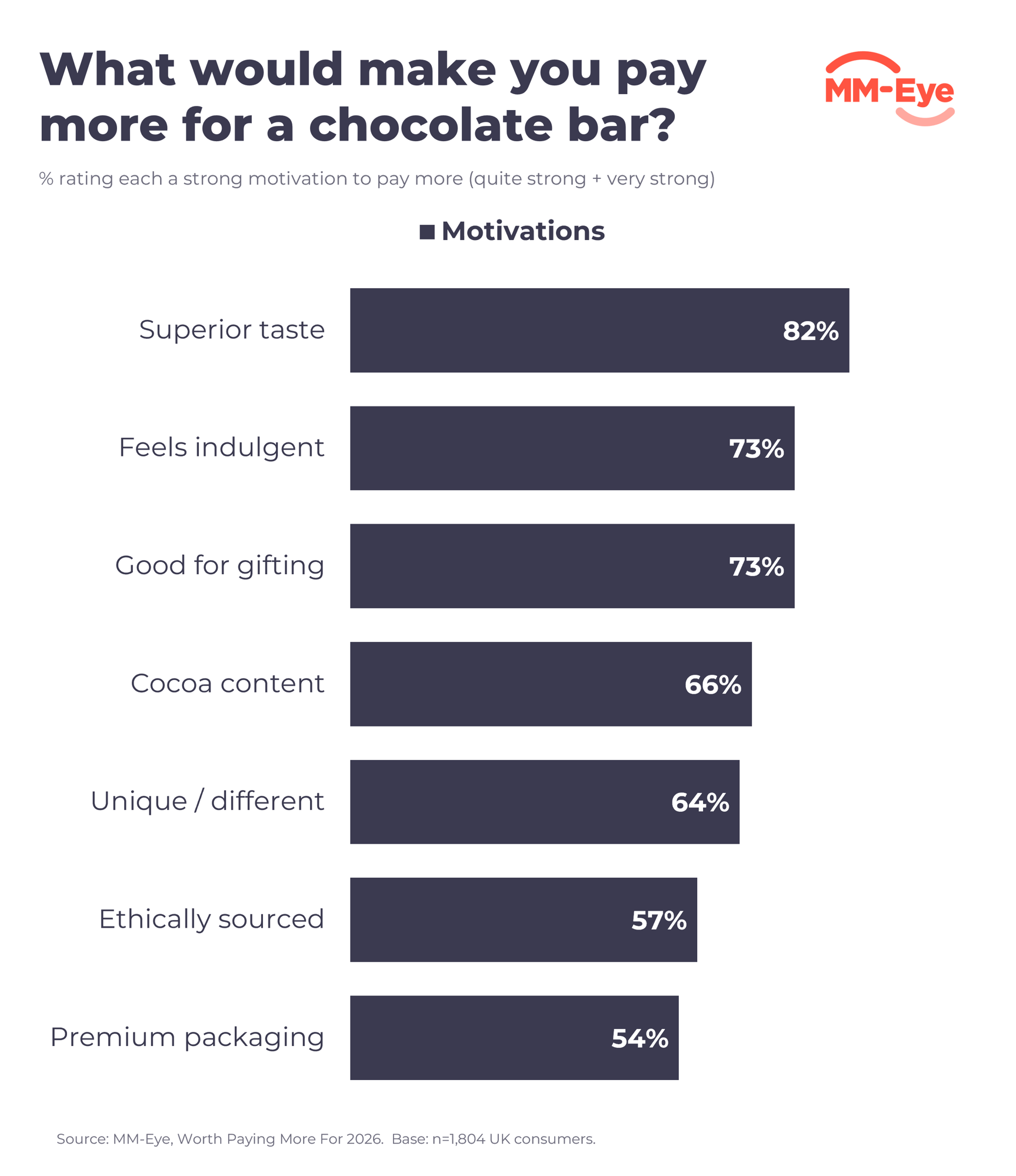
Taste ranks first as a reason to pay more, on 82%. But it only opens the door. What closes the sale sits directly behind it, in joint second on 73%: feeling indulgent, and being good to give as a gift. One is a pure emotional reward, the other an occasion, and both rank ahead of cocoa content (66%), ahead of being unique or different (64%), ahead of ethical sourcing (57%), and well ahead of premium packaging, last on 54%.

Plenty of premium campaigns run this backwards. They open with the finishing cues, the sourcing story, the craft, the beautiful box, the very things that rank last as reasons to pay more, and treat taste as a given to confirm later. The order people actually use runs the other way. Taste first, as the functional gatekeeper. The emotional pull of indulgence second, as the close. Then the supporting proof, and the finishing cues last, as reinforcement rather than reason.

Minisite - Choc WPMF

Two small chocolate findings but put them together and you have the whole of our Worth Paying More For theory in a single aisle. A brand earns a premium when it wins on both the thing you're selling and on the way that thing makes people feel. People don't pay more for reasons alone. They pay more when the feeling and the proof agree. If that holds for something that costs a couple of pounds, it holds for whatever you sell. So the real question is not whether your brand is known, or even whether it is good. It is whether the feeling and the proof are both there, and whether they agree. 


Substance beats status-signalling, consistently

When people pay more, they aren't just buying better. They're buying reassurance, reward and confidence. Quality alone isn't enough.

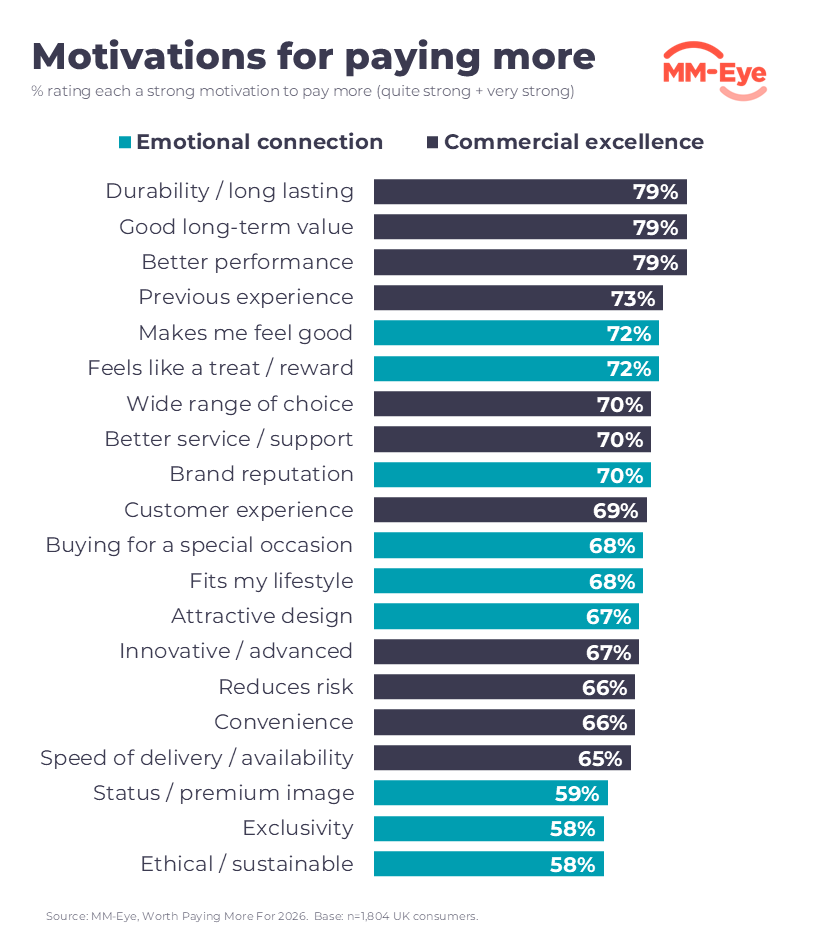
Ask people what motivates them and practical aspects lead: durability, good long-term value and better performance, each a strong motivation for around four in five people (79%). This is the proof talking.

But the feeling is not far behind. Making yourself feel good and the sense of a treat both land at 72%, right on the shoulder of the rational reasons rather than trailing them. The two work together.

And the motivations brands most often assume premium is built on come last of all. Status and premium image (59%) and exclusivity (58%) sit at the bottom of the list. This mirrors what we saw in people's unprompted own words. Premium is about how it feels to you, far more than how it looks to others.

Commercial excellence gives people the proof. Emotion gives them the lift. A brand needs both to leave the ground, and the feeling and the proof have to agree.

WPMF_Post4_Chart_Portrait-2

There's no such thing as a premium shopper

Two people can look at the same price tag and reach opposite verdicts. One sees an obvious "yes". The other sees someone being asked to pay for a logo. Neither is wrong. They simply need different things before it feels like money well spent.

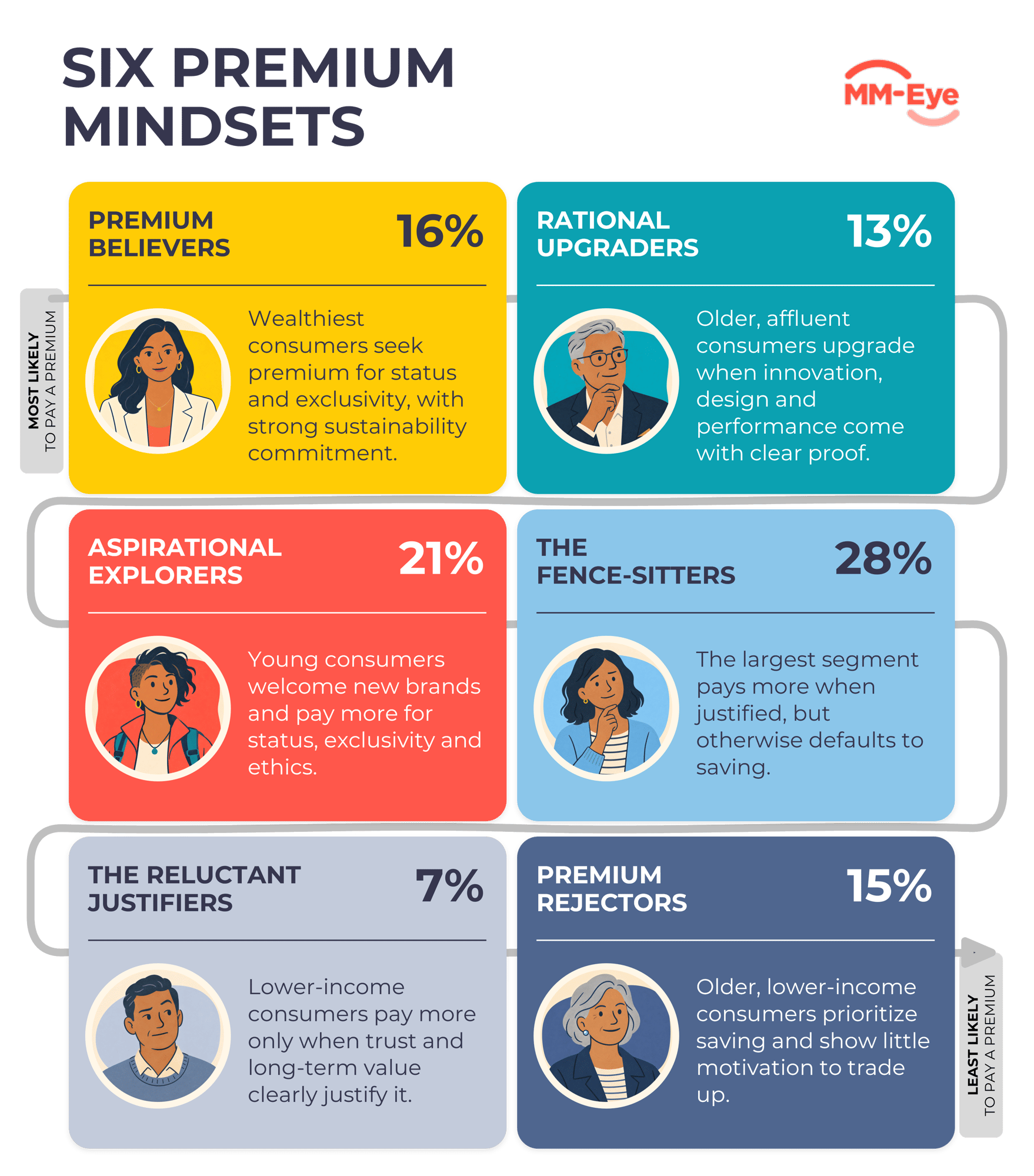
That's the problem with treating "the premium consumer" as one mindset. Premium is not a trait people carry from aisle to aisle. It shifts by category, by person and by occasion. We have identified six distinct mindsets and what tips one into trading up is often the very thing that pushes another away.

Understanding which mindset you are talking to is the difference between a message that lands and one that quietly repels the person you were trying to win.

So before you ask whether your brand is worth paying more for, ask who you're trying to convince. Are you speaking to the believers who just want proof you'll deliver, the explorers who want a story, or the fence-sitters you've never quite convinced?

Six Premium Mindsets in order-1

Let's meet the segments

premium-believers - detail
rational-upgraders - detail
aspirational-explorers  - detail
fence-sitters  - detail
reluctant-justifiers - detail
premium-rejectors - detail

People tell us they care about how things are made. Then they reach the till and pay for something else.

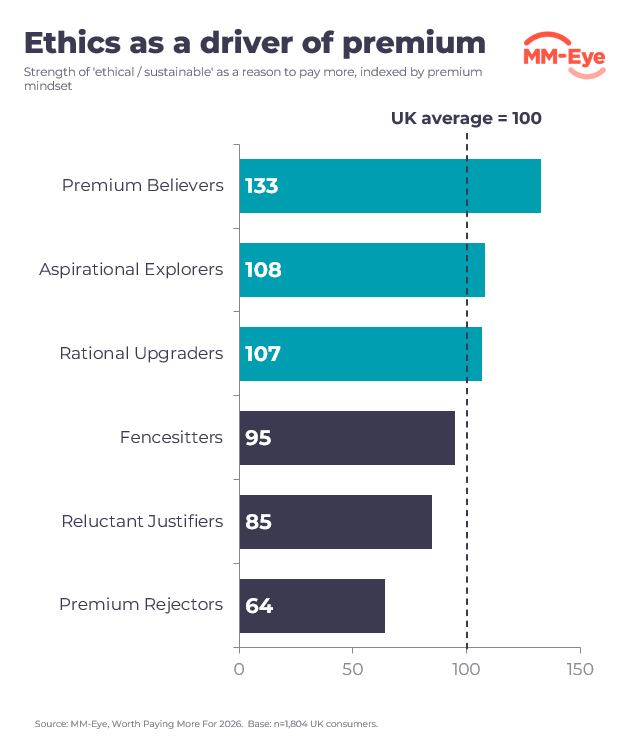
Ethical and sustainable credentials sit towards the bottom of motivations for buying premium. For premium chocolate, where it is often thought to hold more influence on buying behaviours, this is often signalling behaviour. Ethical ingredient sourcing lands near the bottom of the reasons people give for paying more, behind taste, indulgence, gifting and cocoa content.

That looks like a closed case until you look at who is buying. For most people, ethics is a tie-breaker, not a reason. But for Premium Believers and Aspirational Explorers, two of the most valuable premium mindsets, sustainability pulls far harder than average. The lesson is not that ethics fails to justify a premium. It is that ethics rarely justifies one on its own. It strengthens a premium when it connects to something people already want, and it reaches the people for whom it genuinely moves the needle. Done as duty, it reassures. Done as desire, like Tony’s Chocolonely making fairness feel like a flavour, it sells.

Does your sustainability story make people feel something, or just reassure them, and is it reaching the people it actually moves?

Minisite chart

Defender, challenger or expanding brands: same question, different answer

Consumers do not assess every brand on one scale. The same price can feel earned by one brand and resented from another, depending on where that brand already sits in their heads. That is why premium is not a single end point but a position you defend, chase or build towards.

Defending brands, the established premium names, win by keeping both wings strong. The quiet risk is coasting on emotional equity while the proof erodes, or drifting into pure performance while the warmth fades.

Challenger brands usually fly on one wing, a sharp product or a loved story, and grow by adding the one they are missing over time as brand awareness and familiarity grows. The risk is that they continue to fly only on one wing, not building proof or feeling in the other and repeat purchases fade.

Expanding brands, moving up from the mainstream, have to earn the emotional wing rather than simply raise the price, because a higher number without a stronger feeling just reads as more expensive.

Wherever your brand sits, the test does not change. Is the price you are asking matched by both the feeling and the proof?


Nobody wakes up wanting to spend more. They wake up wanting something to be worth it.

Across everything we have learned in Worth Paying More For, that is the quiet shift brands keep missing. Premium is not a price you set. It is a verdict your customer reaches, and they reach it with both their heart and their head.

Here is what that means once you take it off the page and into your brand.

Stop treating "better" as a strategy. Over seven in ten people told us they will pay more when they can clearly see the difference. Read that the other way round and it is a warning. If the difference is not visible, the premium is not payable, however real your superiority is in the lab or the supply chain. Most brands over-invest in being better and under-invest in making better legible. The work is not just building the proof. It is making the proof land in the few seconds someone spends in front of your shelf or your pricing page.

Quality is the entry fee, not the edge. Practical motivations, durability, performance and value, lead the reasons people give for paying more. But almost everyone claims them, which makes them table stakes rather than a difference. The brands that actually command a premium pair that rational proof with an emotional reason to care. Quality gets you considered. Feeling gets you chosen. If your entire premium story is a spec sheet, you are competing on the one dimension your rivals can match.

You are not selling to "the premium shopper." There isn't one. We found six distinct premium mindsets, from Premium Believers who are already sold, to Fence-sitters who need one concrete reason, to Rejectors who will not be moved by image at all. The same message that excites one repels another. The implication is uncomfortable. A single premium positioning, broadcast to everyone, is optimised for nobody. The question is not "how do we justify our premium" but "to whom, and what does each of them need to believe first."

Your competition is not who you think. People do not hold a premium budget for your category. They hold one budget and decide, purchase by purchase, where it is worth stretching. That means you are competing for the same discretionary pound as categories nothing like yours. The brand that wins is not the one that beats its direct rival. It is the one that makes the trade-off feel obviously worth it in the moment of choice.

Ethics is a multiplier, not a reason. On its own, ethical and sustainable sourcing sits near the bottom of why people pay more. But it pulls far harder for the most premium-active mindsets. So ethics rarely justifies a premium by itself, yet it can strengthen one when it connects to something people already want and reaches the people it genuinely moves. Done as duty, it reassures. Done as desire, it sells. If your sustainability story lives on a compliance page, you are leaving its commercial value on the table.

Know which wing you are flying on. Every brand we looked at sits somewhere on two wings, emotional connection and commercial excellence. The Body Shop had the feeling and lost the proof. Dyson had the proof and cooled on the feeling. Both paid for it. Whether you are defending a premium, challenging for one or expanding into one, the diagnosis is the same question asked from a different starting point. Is the price you are asking matched by both the feeling and the proof, and which wing is weaker right now?

Here is the test we would leave you with. Pick your hero product and ask two things about it. Can a customer feel why it is worth more before they have read a word? And can they justify it out loud to someone else afterwards? If the answer to either is no, you have found your next piece of work. That is the conversation we love having. Talk to us about your brand.


Discover our latest blogs

Why do premium brands fail?

Discover what happens when a brand has all feeling and no proof, or vice versa.

Did chocolate earn its price rise?

What separates the brands people recognise from the ones they pay more for? 

Why do consumers pay more?

Five key insights for brands, that we have taken from the Worth Paying More For Study.


Methodology

We surveyed 1,804 UK adults, nationally representative by age, gender, income and social grade in June 2026. Structured questions told us what people do. To understand why, we used our proprietary methodology, ThoughtScape, to reach the emotional depth most surveys leave on the table. Our approach combines open, consumer-led responses with AI probing and thematic coding at scale. The result is a picture of premium built on both the feeling and the proof, across categories.